The first term sheet I ever signed as a founder had redlines on it from three different lawyers before it got to me, and I still managed to give away more than I should have. Not because I'm careless — I spent four years at a big firm drafting these things for clients. Because reading a term sheet as a service provider and reading one as the person whose name goes on the signature page are two different sports. So this guide is the clause-by-clause walkthrough I give founder friends over coffee, with the actual numbers, because vague advice about "negotiating hard" is useless and arithmetic isn't.
What a Term Sheet Actually Is
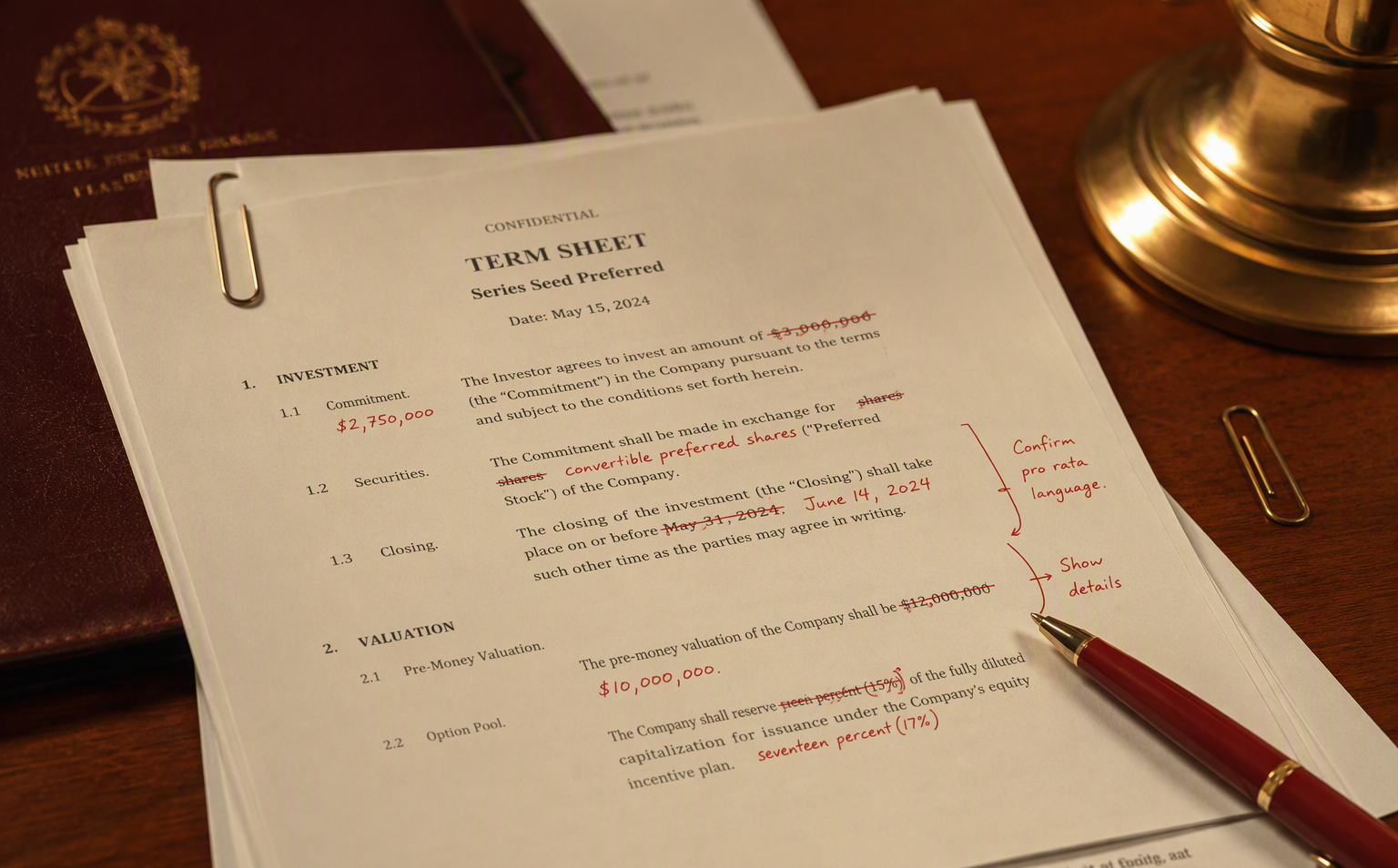
A term sheet is two to three pages. That's it. The full stock purchase agreement, investor rights agreement, voting agreement, and right of first refusal agreement that grow out of it will run over a hundred pages combined, but the term sheet is the skeleton — and skeletons are load-bearing. Everything material about your deal gets decided here: price, preference, board, vetoes, exclusivity. Once you sign it, the long documents are drafted to match, and trying to reopen a point at the definitive-docs stage gets you a polite version of "we already agreed to this."
Here's the part founders get wrong: the term sheet is non-binding. Mostly. Nobody is legally forced to close the round just because both sides signed. The investor can walk because of "diligence findings," a market wobble, or a partner meeting that went sideways, and you have no claim. But two clauses are binding, and they bind you: the no-shop (sometimes called exclusivity) and confidentiality. So you end up in an asymmetric arrangement — they can leave, you can't shop, and you can't tell anyone what happened. Remember that asymmetry the whole time you're negotiating. It's the frame around everything below.
One more structural point. Because the document is short, every clause in it is there because the investor's side wanted it there. Nobody drafts a two-page document and pads it. When you see a provision and think "that seems harmless," ask yourself why it survived the edit. Usually the answer is that it moves money or moves control, in one direction only.
Valuation: The Number Everyone Sees
Let's do the math everyone gets half-right. Say the term sheet offers $5M pre-money valuation and the investor is putting in $1M. Post-money is $6M. The investor owns $1M divided by $6M, or 16.7% of the company. You and everyone else keep $5M divided by $6M, or 83.3%. Clean, right?
Now watch what happens when the term sheet adds a sentence: "The pre-money valuation includes an unallocated employee option pool of 15%." That sentence just moved the pool entirely into your side of the ledger. The investor's 16.7% doesn't change — it can't, it's $1M over $6M. But your 83.3% is now split between founders-plus-existing-holders and a fresh 15% pool. Your actual stake just dropped to about 68%, and the option pool — shares you'll hand to employees over the next two years — was paid for entirely by diluting you. This is called the pool shuffle, and it's the single most common way founders lose 5 to 10 points of ownership without noticing. The defense is a hiring plan. Literally a spreadsheet: roles, titles, expected grant sizes, months. If your plan needs 9%, negotiate to 9%. The investor will grumble and accept, because arguing against your own hiring spreadsheet is a bad look.
Pre-money versus post-money language matters just as much in SAFE conversions, but on a priced round just make sure the cap table exhibit attached to the term sheet shows the post-round ownership in actual percentages, fully diluted. If the term sheet doesn't include the exhibit, ask for it before you sign anything. An investor who resists putting the math on paper is telling you something.
Liquidation Preference: Who Eats First
The liquidation preference decides what happens when the company sells for less than everyone hoped — and sometimes when it sells for plenty. The market standard, the genuinely founder-fair standard, is 1x non-participating. That means: at an exit, the investor chooses the better of (a) getting their $1M back, or (b) converting to common and taking their 16.7% of the proceeds. One or the other, whichever is bigger. In any decent outcome they convert, everyone shares pro rata, and the preference was just downside insurance. That's fine. That's the deal.
The toxic version is participating preferred, especially at a multiple. With participation, the investor takes their preference off the top and then also takes their percentage of what's left. Double-dipping. Run it: company raised $4M on 1x participating preferred for 40% of the company, sells for $12M. Investor takes $4M first, then 40% of the remaining $8M — another $3.2M. Total $7.2M out of a $12M exit, or 60% of the proceeds for a 40% owner. Common — you, your co-founder, every employee with options — splits $4.8M. At 2x participating, the investor takes $8M off the top, then 40% of the remaining $4M, walking with $9.6M — 80% of a $12M sale — while everyone who built the product shares the crumbs. I've seen exactly this structure presented with the phrase "fairly standard protections." It is not standard. The NVCA model documents treat 1x non-participating as the baseline, and every data set on seed and Series A deals from the last decade says the same. If a term sheet arrives with participation, your first redline deletes it. Not negotiates it down. Deletes it.
Watch for stacked preferences across rounds too. Series B preferred usually sits senior to Series A, which sits senior to common. Raise three rounds and there can be a whole staircase of money that gets paid before common sees a dollar. This is why a mediocre exit can produce a near-zero outcome for founders even at a sale price that sounds impressive at dinner. Always model the waterfall — every round, every preference, your likely exit range — before you sign the round in front of you.
Anti-Dilution: The Clause That Punishes Survival
Anti-dilution protection reprices the investor's shares if you later raise at a lower valuation — a down round. Two flavors exist, and the difference between them is the difference between a bruise and an amputation.
Full ratchet says: if any future share sells cheaper than the investor's price, the investor's conversion price resets to that cheap price, as if they'd bought at the low price all along. The cruelty is in the asymmetry — it doesn't matter if the down round was tiny. Sell $200,000 of bridge stock at half the old price to keep the lights on, and the seed investor's entire position doubles in share count. Who gets diluted to make those new shares? Common. You. One desperate bridge can erase years of founder equity, and every future investor who looks at the cap table will see the bomb still ticking, because any future down round triggers it again. Never accept full ratchet. I'd rather take a lower valuation with clean terms than a headline number chained to a ratchet, and it's not close.
Broad-based weighted average is the acceptable version. It adjusts the conversion price by a formula that weighs how many shares were sold cheap against the whole fully diluted share count. Small down round, small adjustment. The investor gets real protection against a genuine repricing of the company, and a tiny bridge doesn't nuke anyone. This is what the standard forms say, it's what most funds accept without a fight, and if an investor insists on full ratchet "for downside protection," the honest question back is: why does your model assume I'll miss my plan badly enough to need it?
There's also a related landmine called the pay-to-play provision, where investors who don't participate in the down round lose their anti-dilution or convert to common. That one actually protects founders, so if it shows up, leave it alone.
Board Composition: Control You Can Count
Founders obsess over valuation and sign whatever board structure is in front of them. Backwards. Valuation is about money in a good outcome; the board is about power in every outcome, including the Tuesday when things get hard. And board math is simple counting.
After a seed round, the founder-friendly structure is four seats: two common (the founders), one investor, one independent everyone genuinely agrees on. You can't be outvoted by the investor bloc without the independent, and the independent's job is to break ties, not to caucus with the fund. The structure to refuse is 1 founder + 2 investors — at seed, that means you can be fired from your own company by the two people who just wired you money, and it happens, usually framed as "bringing in experienced leadership." If an investor insists on a board majority at seed, that's not governance, that's a takeover with extra steps.
Two details worth the fight. First, define how common's seats are elected: holders of a majority of common stock, voting as a separate class. Not "majority of all stock," or the preferred majority can fill your seat. Second, interrogate the independent seat. Who picks? A "mutually agreed" independent who turns out to be the lead investor's former colleague from business school is a third investor seat wearing a costume. Propose names yourself — an operator you respect, someone with no financial tie to the fund — and get the nomination mechanism in writing.
Protective Provisions: Vetoes by Another Name
Protective provisions are the list of things the company cannot do without the preferred holders' consent. Some are legitimate. An investor who owns a fifth of your company deserves protection against you selling the whole thing out from under them, liquidating it, selling the core IP, or creating a new class of stock senior to theirs. The standard list looks like: sale or merger of the company, liquidation or dissolution, sale of substantially all IP or assets, charter amendments that hurt the preferred, authorizing a new series with senior rights, and taking on debt above a negotiated threshold — say $250,000 at seed, more at Series A. Fine. Sign that.
The red flags are the vetoes over operations. Approval of the annual budget means every hire, every ad campaign, every office lease can be held up. Approval over hiring or firing executives means your VP of Engineering offer waits on a fund partner's calendar. Approval over "any expenditure above $X" with X set absurdly low is the same veto wearing a different hat. Each of these converts your company from founder-run to investor-managed without ever saying so, and each one will be used — usually politely, usually "just this once," always at the worst possible moment for speed. When you see operational vetoes, don't negotiate the thresholds first. Strike the provisions. Threshold-tuning is the fallback for when striking fails.
Also read which class gets the veto. Standard is approval by a majority of the preferred. Some term sheets give each series its own separate veto, which means your smallest investor — maybe a $150,000 check in the seed — can single-handedly block a Series C acquisition offer. One majority-of-preferred vote, all series together, is the answer. A $150,000 check should not hold a $30M exit hostage.
Drag-Along: When a Majority Really Is a Majority
The drag-along says: if a defined group approves a sale of the company, everyone else has to sell too — you can't have a holdout founder blocking a deal the majority wants. In principle, reasonable. In practice, the defined group is everything.
The founder-safe version requires both a majority of the common and a majority of the preferred to approve the sale before anyone gets dragged. Two gates. Because preferred and common have opposite interests in mediocre exits — remember the preference stack — a drag that only requires the preferred majority lets investors force through a sale at a price where they take their preference and convert-or-not, and common gets pocket lint. With the common gate included, a deal that zeroes out the founders needs founder votes to pass. That's the whole point.
Check two more things in the drag clause. The price mechanism: some drags let the sale proceed at "any price approved by the board," which with a bad board seat split is the veto problem again. And liability: dragged stockholders should be on the hook only for pro rata escrow and indemnity, capped at their actual proceeds, never uncapped joint liability. Reps and warranties beyond that — especially on IP and litigation — belong to the company, not to you personally.
ROFR, Co-Sale, and the Trust Trap
Right of first refusal and co-sale rights are standard and mostly fine. ROFR means that before you sell your shares to a third party, the company (and then the investors) can buy them on the same terms. Co-sale means if you do find a buyer, investors can add their shares to your sale pro rata, shrinking how much of your own stock you can move. Together they make founder stock illiquid without board approval, which investors want, and at seed stage it's usually not worth fighting — nobody should be selling founder shares early anyway.
But read the transfer restrictions section for the exceptions, because the exceptions are where estate planning lives. A decent term sheet lets you transfer shares to a family trust, or to family members for estate purposes, without triggering ROFR or co-sale, as long as the transferee signs onto the agreements. I've read term sheets where the carve-outs covered affiliates of the investors but not founders' trusts — meaning the fund could reshuffle its own holdings freely while you couldn't move a single share into a trust for your kids without permission. If the carve-out list doesn't include trusts and family transfers, add it. It's a two-line fix and any fund that balks at it should explain why your estate plan is their business.
The No-Shop: Your Runway Is Their Leverage
The no-shop is the binding clause, remember, and it's where term sheets actually hurt people. Sign a 60-day exclusivity with one fund and you are legally barred from soliciting or entertaining other offers while your bank account drains. The fund knows your runway — it's in the financial model you sent. Every slow week of diligence tightens the vise, and the classic endgame is the retrade: week seven, "diligence turned up some concerns, we can still do the deal at a lower price." With no other option and six weeks of runway left, founders take it. That's not a hypothetical. That's a Tuesday in this industry.
Your defenses. Cap exclusivity at 30 days, 45 at the absolute outside, with an automatic expiration — no auto-renewal, no extension "while diligence continues." And insist on a matching-right exception: if another bona fide written offer arrives unsolicited, you can present it and the fund gets a short window — 5 business days is common — to match or better it. Investors hate this clause because it works. It converts your exclusivity from a dead end into an auction floor. A fund that genuinely wants the deal will close inside 30 days anyway; the no-shop only matters to them if they plan to use the time against you. Treat resistance to a short no-shop as information about their intentions, because that's exactly what it is.
Closing Conditions: The Escape Hatches
Flip to the back of the term sheet and read the closing conditions — the list of things that must be true before the money actually moves. Standard conditions are boring and fine: representations and warranties hold true at closing, key agreements get signed, a 409A valuation gets done so employee options can be priced correctly, counsel delivers a legal opinion, and necessary consents and filings happen. All of that is process. You'll do it in a few weeks with decent lawyers.
The condition to circle is the material adverse change clause — "no event shall have occurred that has or could reasonably be expected to have a material adverse effect on the company." Vague, right? That's the point. A MAC clause is a standing permission slip to walk, and in shaky markets it gets used on companies whose only adverse change was that the fund's own portfolio needed the capital more. You can't strike it entirely — no institutional fund signs without one — but you can narrow it: define what counts, carve out general market and economic conditions, and add "prospects" language only if you must. The tighter the MAC, the more your signed term sheet is worth. A wide-open MAC plus a 60-day no-shop is not a deal. It's an option the fund bought from you for free.
Also check for conditions that are really re-openers: "completion of confirmatory diligence" (fine, bounded), "satisfaction with background checks" (fine), "approval by the investment committee" (danger — it means the person across the table can't actually say yes). If IC approval is still pending, the term sheet is a maybe, and you should treat it that way and keep every other conversation warm until the check clears.
How I'd Actually Run the Negotiation
Sequence matters more than founders think. First, never negotiate alone on a call — every call gets a follow-up email summarizing what was agreed, because memory at funds is conveniently elastic. Second, negotiate structure before price sounds crazy, but concede small on price to win big on structure: dropping the pre-money ask by $500K to kill participation is the best trade you'll ever make. Third, keep two processes alive as long as possible; the only real leverage a founder has is another term sheet, and funds know it, which is why the no-shop exists. Fourth, get a lawyer who does venture deals every week — not your uncle, not the firm that did your landlord's lease — and have them redline before you sign, not after. Venture counsel at seed costs less than one bad clause.
And keep score on the things that matter. After any term sheet, you should be able to write down, from memory: your fully diluted post-round percentage, the preference type and multiple, the anti-dilution flavor, the board seat count, the veto list length, the drag threshold, and the no-shop length. Seven numbers. If you can't recite them, you don't understand your own deal yet, and the person across the table — who has closed two hundred of these — absolutely does. That gap is where founder equity goes to die.
If you're earlier than a priced round and raising on SAFEs, most of this still applies at conversion — the cap and discount you sign today become the economics above tomorrow. Our SAFE guide covers that math in the same detail, and the due diligence checklist covers the paperwork the closing conditions will demand.